
Ingredients and Preparation
Beer begins with a small group of ingredients that each contribute a distinct function. Water forms most of the finished drink, while malted grain supplies the material from which brewers develop fermentable sugars. Hops and yeast contribute different parts of the beer’s character, and some recipes include additional grains or flavorings. Preparing each ingredient in advance helps it reach the brewing stage in a usable form.
The main brewing ingredients
The core beer ingredients are water, malted grain, hops, and yeast. Their proportions and characteristics give a recipe its starting structure, while optional additions can broaden its flavor and texture.
- Water: As the largest component by volume, water affects the beer’s flavor and mineral balance. Its dissolved minerals can also influence how the grain behaves during brewing.
- Malted grain: Barley malt is the usual source of fermentable sugars, along with proteins and compounds that contribute color, body, and grain-derived flavor.
- Hops: The flowers of the hop plant contribute bitterness that balances malt sweetness, as well as aroma compounds associated with citrus, herbs, pine, or flowers.
- Yeast: Brewing yeast uses fermentable sugars and produces alcohol and carbon dioxide, while its strain can also contribute distinctive aromas and flavors.
- Additional grains: Wheat, oats, and other cereal grains may supplement barley, changing the recipe’s balance of grain character, body, and texture.
- Other additions: Some recipes use fruit, spices, or sugars to add particular flavors or adjust the beer’s composition beyond the four core ingredients.
Each ingredient has a different role rather than serving as a simple substitute for another. The mix shapes the brewing process: a grain-focused recipe, for example, calls for different preparation than one built around fruit or spices.
Preparing ingredients for brewing
Preparation makes the grain and other ingredients ready for their respective brewing stages. Brewers typically identify and measure the recipe’s ingredients before work begins, keeping malt, hops, and any additions separate so each can be handled as intended. Yeast may be supplied dry or as a liquid culture; its packaging and condition should be checked before use. Malted grain is crushed into grist before it is mashed. The aim is to break the kernels and expose their interior while retaining much of the husk, which helps the crushed malt remain suitable for the next stage. A mill set too coarse leaves more kernels unbroken; an overly fine crush creates excess flour. Hops and optional ingredients are also portioned and kept identifiable for their planned use. With the grain crushed and the remaining ingredients organized, the practical approach is to prepare only what the recipe calls for and keep each ingredient ready for its own brewing stage.
Mashing and Separating the Wort
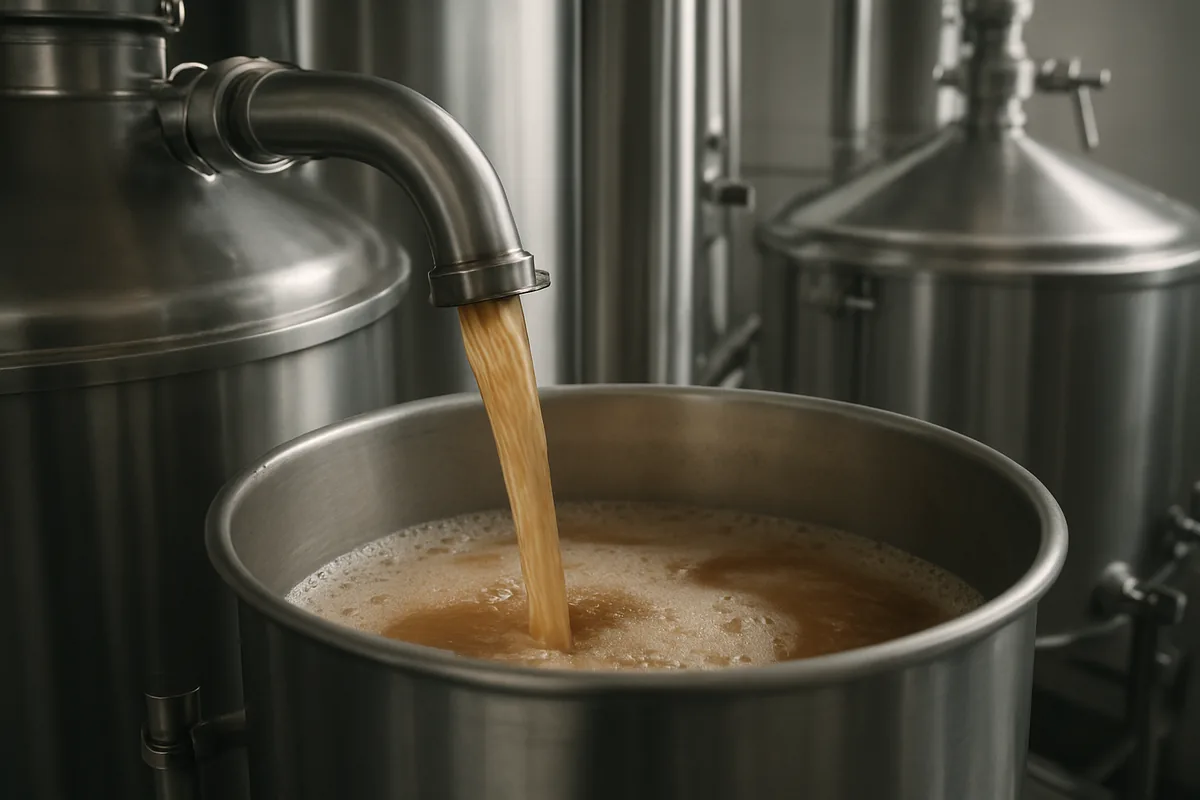
Mashing and separation turn crushed malt into the liquid base used for the next stage of brewing. During the mash, water and malt enzymes make grain starches available as fermentable sugars. The mash is then drained so the liquid can be kept apart from the solid grain material. Together, these steps determine what enters the kettle as wort.
Mashing crushed malt
In mashing, crushed malt is mixed with hot water in a mash tun, allowing enzymes in the grain to break starch into sugars that yeast can ferment. The grain supplies starch and enzymes, while water hydrates the grist and provides the medium for those reactions.
- A typical single-infusion mash uses about 2.5–3.5 litres of water per kilogram of malt, creating a workable mixture for enzyme activity.
- Brewers commonly hold the mash near 63–68°C for about 60 minutes; the chosen temperature affects which sugars enzymes produce.
- Beta-amylase releases maltose from starch chains, contributing fermentable sugars that can later be converted into alcohol by yeast.
- Alpha-amylase breaks starch into shorter chains, including dextrins, which generally remain less fermentable and contribute to the beer’s body.
- Crushing the malt exposes its starchy interior while leaving much of the husk intact, helping water reach the grain without turning it into flour.
- As the mash rests, enzymes act on the hydrated grain; the resulting liquid contains dissolved sugars and other compounds extracted from malt.
The practical result is a sweet, sugar-bearing mash ready for draining; a stable temperature and an even mix support consistent extraction.
Separating wort from grain
After mashing, the liquid wort is drained away from the spent grain solids, commonly in a lauter tun fitted with a slotted false bottom. The false bottom holds back most grain particles while allowing liquid to flow into the kettle. Brewers may recirculate the first cloudy runnings over the grain bed until the runoff becomes clearer, then collect the wort. Some methods use sparging: hot water is passed through the grain bed to rinse out remaining dissolved sugars. The grain solids left behind are spent grain; the collected liquid, not the solids, is the material carried to the next brewing stage. Separating them matters before boiling because excess grain particles can interfere with the wort and may affect the finished beer. A steady drain through an intact grain bed is a practical way to collect wort while limiting solids in the kettle.
Boiling and Adding Hops
Boiling is a distinct stage in the beer brewing process, transforming the separated wort before it is cooled for fermentation. Heat helps stabilize the liquid, while evaporation and protein changes affect its composition. Brewers may add hops at different points in the boil because exposure changes the balance of bitterness, flavour, and aroma. The choice depends on the beer’s intended character, and no single schedule suits every style.
Boiling the wort
After wort has been separated from the spent grains, it is brought to a steady boil. This heat treatment reduces viable microorganisms and stops the enzymes that were active during mashing. Evaporation also concentrates the liquid, while proteins gather into visible clumps known as the hot break; these can later be left behind when the wort is transferred.
Boiling helps drive off volatile compounds, including dimethyl sulfide (DMS), which can otherwise give beer a cooked-corn aroma. The extent of evaporation and protein formation depends on the equipment and intensity of the boil, so brewers monitor the wort rather than rely on one universal result. Hops can be added during this stage, with their contribution shaped by how long they remain exposed to heat.
When the boil is complete, the hot wort must be cooled before yeast is introduced. This handoff ends the hot-side work and prepares the liquid for the next brewing stage, without treating the boil itself as part of fermentation.
Hop timing and contribution
Hop additions can be placed across the boil to emphasize different qualities. The ranges below are common examples measured backward from the end of the boil, not a required schedule; recipe, hop variety, and brewing method all affect the result.
| Addition point | Typical timing | Main contribution |
|---|---|---|
| Early-boil addition | About 45–60 minutes before the boil ends | More bitterness; prolonged heat converts hop alpha acids into bittering compounds. |
| Later-boil addition | About 10–20 minutes before the boil ends | Bitterness with more retained hop flavour than a long-boil addition. |
| Near-end addition | Final 0–5 minutes, or after heat is switched off | More volatile hop flavour and aroma, with generally less bitterness than an early addition. |
Longer exposure tends to favor bitterness, while late additions preserve more aromatic compounds that can be lost to heat. These are tendencies rather than guarantees: hop form, wort conditions, and post-boil handling also influence what remains in the beer. Some recipes use several addition points, while others rely on one or omit hops.
Choose each point by the intended balance: an early addition for firmer bitterness, a later one for flavour, and a near-end addition when aroma matters most.
Fermentation
Fermentation is the stage when yeast turns wort into beer. The yeast consumes fermentable sugars and releases alcohol and carbon dioxide as it grows and works. Its strain and the conditions in the fermenter shape how quickly and completely this change proceeds, as well as the beer’s character. Yeast strain and fermentation management explain why the same wort can produce different results.
What yeast does
Yeast ferments sugars dissolved in wort, using them for energy and producing alcohol and carbon dioxide as by-products. This activity changes the sweet, unfermented liquid into beer: sugar levels fall, alcohol develops, and gas builds during active fermentation. Carbon dioxide may escape through a fermenter’s airlock, while some remains dissolved in the beer.
Fermentation is not simply a conversion of sugar into alcohol. Yeast also produces flavor-active compounds, including esters and higher alcohols, whose amounts vary with the strain and fermentation conditions. These compounds can contribute fruit-like, spicy, or other distinctive notes, so yeast is an active part of a beer’s flavor profile rather than a neutral processing aid.
Different yeast strains also vary in how they use available sugars and how much character they contribute. A brewer choosing yeast for an ale or lager is selecting a fermentation behavior as well as a flavor profile. The strain therefore helps determine the change from wort to beer and the qualities of the finished brew.
Conditions and beer character
Yeast choice and the fermenter environment work together to shape fermentation and the beer’s character. Key influences include:
- Yeast strain: Ale and lager strains differ in fermentation behavior and flavor contribution, affecting whether the resulting profile is cleaner, fruitier, or more expressive.
- Temperature stability: Yeast activity responds to temperature; maintaining a steady fermentation environment helps prevent unwanted swings in flavor and fermentation performance.
- Fermenter environment: A clean, appropriately sealed vessel limits exposure to contaminants, while an airlock allows carbon dioxide to escape without leaving the fermenter open.
- Yeast health and pitching: Healthy yeast introduced in an adequate amount is better positioned to begin fermenting evenly and complete its work without undue stress.
- Fermentation progress: Changes in bubbling and gravity readings can indicate activity, but bubbling alone does not confirm that fermentation is complete.
For consistent results, match a suitable strain to the intended beer style and keep the fermentation environment stable rather than relying on a single sign of activity.
Conditioning and Packaging
After fermentation, beer may be held before it is transferred into its final container. This interval, often called conditioning, can help the beer settle and develop a more integrated character. Its length and method depend on the beer style and the brewery’s process, rather than following one fixed schedule. Packaging then places the finished beer in containers suited to storage and service.
Conditioning after fermentation
Conditioning is a period of rest after fermentation, not one mandatory technique. Brewers use it to let suspended yeast and other particles settle, soften sharp edges, and allow flavors to come together. Some beers are ready after a short rest of several days; others benefit from weeks of maturation. The needed time depends on the style, recipe, and intended character, so a single duration does not suit every batch.
Temperature can shape this stage. For example, cold conditioning at roughly 0–4°C for several days or longer can encourage particles to settle and produce a clearer beer. Lagering commonly involves storage close to 0–2°C for weeks, while many ales mature over days or a few weeks at warmer cellar-like temperatures. These are typical approaches, not requirements: some beers are packaged with little additional tank time, while others are held longer to reach their desired profile.
Conditioning may take place in a tank or, for some beers, continue after packaging. The main purpose remains to bring the beer to its intended state before it is released: clearer and more settled when that suits the style, or simply more mature when extended rest improves its character. The process is chosen for the beer, not applied as a fixed step with identical timing for every brew.
Packaging the finished beer
Once the beer has reached the intended condition, it is transferred from its holding vessel into a suitable package. Common formats include cans, bottles, and kegs; breweries select among them according to how the beer will be stored, transported, and served. Carbonated beer requires containers designed to hold pressure, and packaging systems are arranged to limit contact with air because oxygen can dull fresh flavor during storage.
Containers also help protect the finished beer from handling and, depending on the material, light. For instance, cans block light, while brown glass offers more protection than clear glass. The final choice affects practical factors such as serving format and storage, but does not change the beer’s earlier brewing stages.
In practical terms, conditioning gives beer the time its style needs, and packaging puts it into a container that can hold and protect it. The right combination is the one that preserves the intended character from the brewery to the drinker.
Fermentation, Conditioning and Packaging
The final stages turn freshly brewed wort into a stable, ready-to-serve beer. They follow a clear order: yeast activity comes first, maturation may follow, and packaging comes last. The length of this sequence varies with the beer style, especially for lagers that mature cold. Each stage prepares the beer for the next without changing the basic brewing sequence.
How the final stages fit together
After yeast has converted fermentable sugars, primary fermentation slows and the beer approaches its expected final gravity. Brewers commonly confirm that gravity readings remain unchanged for two or three days before moving the batch forward. This stable reading signals that active fermentation has largely finished.
Conditioning follows when the beer needs more time to mature, clarify, or develop a smoother profile. It may last several days or weeks; lagering extends maturation at cold temperatures, often close to 0–4°C (32–39°F). Some beers move directly from fermentation to packaging, while others are filtered or allowed to settle first.
Once the beer is ready, it is transferred into bottles, cans, or kegs and sealed. Carbonation can develop from added fermentable sugar in bottles or be supplied with carbon dioxide in a keg. In this beer brewing process, each step depends on the previous one: fermentation establishes the beer, conditioning prepares it, and packaging protects it for storage and service. For a reliable home batch, package only after gravity is stable and any chosen maturation is complete.